
The Bamboo Road to Vision 2030
By Tachiona Kamikani and Tinashe Chidau
Every night, after a full day of intensive training in Beijing, we return to our hotel rooms and recline on beds made from bamboo, covered in linen woven from bamboo fibres. And every night, the same thought lingers long after the lights are switched off: How do we take this back home?
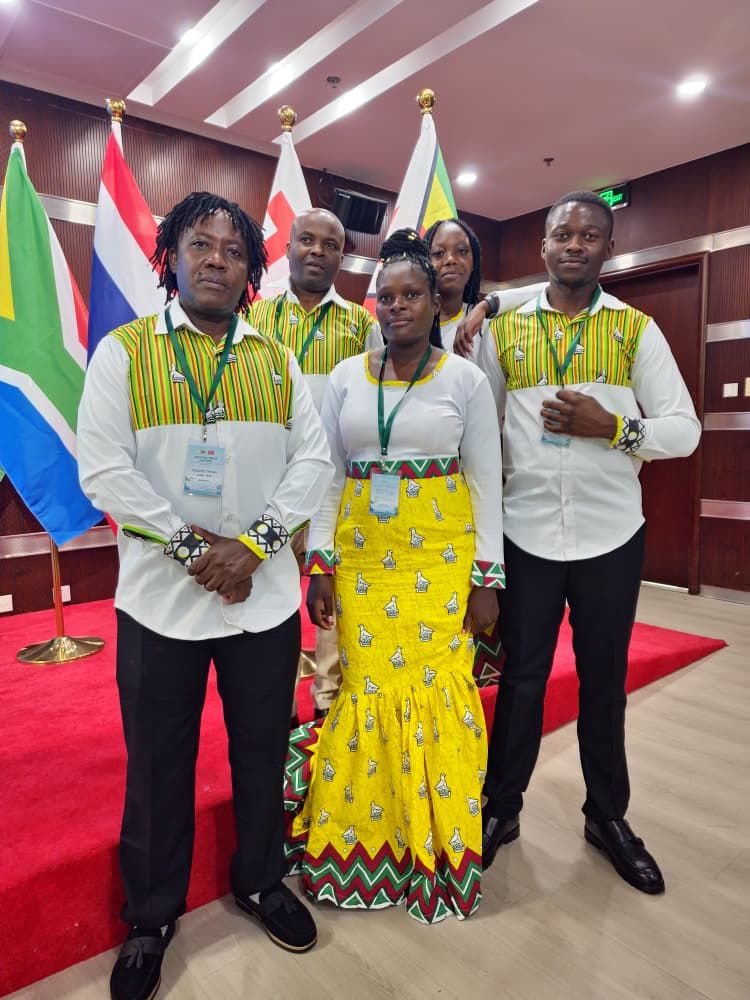
We are part of the 30 delegates from nine countries currently participating in the Seminar on Bamboo and Rattan Innovation Technology for Developing Countries, hosted by the International Centre for Bamboo and Rattan (ICBR) in Beijing. The seminar runs from 4 June to 17 June 2026, and even at the midway point, it is already clear that we are not simply being given a product. We are being given a template for transformation.
The countries represented speak to the truly global reach of this endeavour. From Africa, we have delegates from Zimbabwe, Kenya, Rwanda, South Africa and The Gambia. Moldova has two representatives, and participants have also travelled from Thailand, Tonga and the Solomon Islands. As Zimbabwe’s own President, His Excellency Dr. ED Mnangagwa, often says: “Leave no one and no place behind.” Here, under the banner of South-South Cooperation and the Belt and Road Initiative, that philosophy is being put into practice.
THE WISDOM OF FISHING
There is a Chinese proverb that has rightly become a cornerstone of China-Africa cooperation: “Give a man a fish and you feed him for a day; teach him to fish and you feed him for a lifetime.” This is not merely a nice sentiment. It is a governing principle that has shaped China’s engagement with developing nations. Since 2012, China has sent more than 400 agricultural experts to Africa and trained over 70,000 agricultural technicians across the continent. It has established 24 agricultural technology demonstration centres and introduced more than 300 advanced agricultural technologies, increasing local crop yields by an average of 30 to 60 per cent, benefiting more than 1 million farming families.
Our bamboo seminar is a direct extension of that same philosophy. We are not here to receive bamboo products. We are here to learn how to build a bamboo industry from the ground up.
And what an industry it is.
A KINGDOM OF BAMBOO
China has the world’s richest bamboo resources and is the most developed in their utilisation, earning the well-deserved title “Kingdom of Bamboo”. The numbers are staggering. In 2025, the bamboo industry output in China exceeded 520 billion yuan. The country boasts nearly 8 million hectares of bamboo forests, producing an average of 150 million tons of bamboo each year. More than 10,000 bamboo processing enterprises operate across the nation, and the entire industry chain employs more than 29 million people.
These are not abstract figures. They represent livelihoods, rural revitalisation and a genuine solution to environmental challenges. Bamboo matures in just three to five years, is highly durable and fully biodegradable, and has an impressive carbon sequestration rate. As China implements its 2022 initiative to substitute plastic with bamboo, the applications are expanding into everything from eco-friendly tableware and medical swabs to laptop packaging, bamboo keyboards, speakers, and even automotive interiors.
We are not being asked to reinvent the wheel. We are being invited to stand on the shoulders of a nation that has spent 5,000 years refining its relationship with bamboo and has now built a multi‑billion‑dollar industry on that foundation.
MORE THAN A CLASSROOM
What makes this seminar exceptional is that the learning does not stop at the lecture hall. The curriculum has been carefully curated to provide a holistic picture of development. And crucially, that includes Chinese culture.
We visited the Great Wall of China. We visited the Summer Palace. A casual observer might mistake this for tourism. But a diligent student understands that nothing in this programme is accidental.
Consider the Great Wall. To ascend its steep steps is to confront the sheer magnitude of human perseverance. Constructed over centuries by generations of labourers, the Wall stands as a monument to commitment. The Summer Palace, with its meticulously curated gardens and pavilions, speaks to the same truth: great achievements require sustained effort over long periods of time.
The instructors have gone out of their way to unravel how China has transformed its economy since 1978. The lesson is clear. Transformation starts with getting organised. It requires commitment to a defined goal. It demands the discipline to remain committed throughout the pursuit. And once the goal is achieved, you move on to the next one.
China’s economic take‑off began with agricultural reforms. The country did not jump straight to high‑tech industries. It built foundations first. Today, as Beijing dazzles with breathtaking skyscrapers and flawless technology, it is easy to forget that the foundations were laid long ago. But the seminar instructors have ensured that we do not forget.
A ZIMBABWEAN PERSPECTIVE
For Bamboo Zimbabwe, this training arrives at a pivotal moment. Our nation is firmly on the path towards Vision 2030, the national development plan aimed at achieving an upper‑middle‑income economy within the next four years. The Second Republic has created policy frameworks that emphasise value addition, beneficiation, job creation, and rural industrialisation. The message is clear: every Zimbabwean has a role to play in nation‑building.
Bamboo Zimbabwe is playing its part. We are actively engaged with our government, with traditional leaders, with technical departments and with international partners. We have proven that bamboo is not a theoretical opportunity but a practical one, ready for scaling. What we have lacked—until now—is the depth of knowledge and technical expertise that this seminar provides.
We are fortunate that we do not have to start from zero. China has built the road. We simply need to learn how to walk it.
THE ROAD AHEAD
As the seminar continues, the delegates from nine countries exchange not just business cards but ideas. We share our national contexts, our challenges and our ambitions. There is a genuine camaraderie among us, born of a shared recognition that bamboo can be a catalyst for sustainable development across continents.
For our part, we carry the hopes of Bamboo Zimbabwe and, We believe, of everyone in our nation who sees the potential for a greener, more prosperous future. When we return home, We will not return empty‑handed. We will return with knowledge, with connections, and above all, with a clear plan.
The Chinese leadership has taught us how to fish. Now it falls to us to come back home and cast the nets.
 News Sport Online