
By Tendai Chisiri
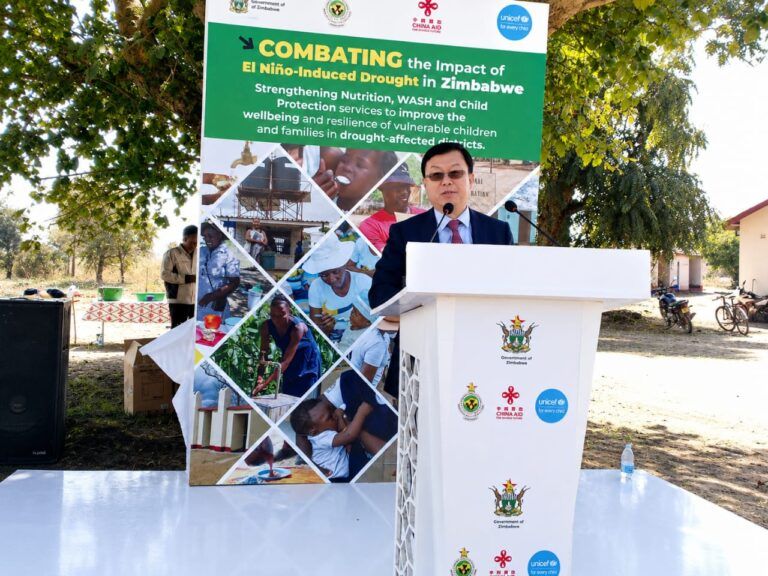
MUREHWA – The Government of Zimbabwe, with support from the People’s Republic of China and UNICEF, on Thursday officially launched a 24-month programme to combat the impact of the El Niño-induced drought, targeting more than 212,000 people across eight of the worst-affected districts.
The “Combating the impact of El Nino-induced drought in Zimbabwe” programme was launched at Kowoyo Clinic in Goromonzi East, Goromonzi District, Mashonaland East Province by UNICEF Zimbabwe Representative Etona Ekole, Chinese Ambassador to Zimbabwe H.E. Zhou Ding, and Deputy Minister of Health and Child Care Hon. Sleiman Timios Kwidini.
Speaking at the launch, Ms. Ekole said the 2023/2024 agricultural season brought one of Zimbabwe’s most severe El Niño droughts in more than four decades.
“The drought left an estimated 7.6 million people facing food insecurity, contributing to deteriorating nutrition outcomes, reduced the diversity of children’s diets and placed families – particularly those already living in vulnerable circumstances – under immense pressure,” she said.
By July 2024, she noted, 4% of water points had dried up, forcing communities to rely on unsafe sources and increasing risks of diarrheal and water-borne diseases.
Zimbabwe currently ranks 171 out of 185 countries on the NDGAIN Index, which measures vulnerability to climate change. Ms. Ekole said this underscores “the urgency of sustained investment in climate-resilient services for children.”
Ambassador Zhou Ding said the new project builds on China’s previous drought interventions, including three batches of emergency food aid totalling 10,000 metric tonnes and the 300 Boreholes Project that delivered clean water to over 75,000 people.
“This programme stands as another powerful testament to the fraternal bond between China and Zimbabwe,” he said. “Once fully implemented, it will deliver direct support to more than 200,000 people across eight drought-stricken districts.”
The project will deliver integrated interventions in nutrition, WASH, and child protection. Ambassador Zhou added that China had also provided support through UNFPA, WFP, UNDP and FAO in recent years, and announced new zero-tariff treatment for Zimbabwean exports to China effective 1 May 2026.
Implementation of the programme began in January 2026. Officials said the timing is critical as a strengthening El Niño raises the risk of another drought in the 2026/27 season.
“This programme will help communities prepare for and reduce the potential impact of the next drought on children and their families,” Ms. Ekole said. “What matters now is timely delivery, accountability and measurable impact.”
She said the programme’s partnership model brings together UNICEF, the Ministry of Health and Child Care, the Civil Registry Department, the Ministry of Lands, Agriculture, Fisheries, Water and Rural Development, local authorities, traditional leaders and community structures.
The launch was also attended by Minister of State for Mashonaland East Hon. Itayi Ndudzi, representatives of Prospect Lithium Zimbabwe, and traditional leaders from Goromonzi.
In closing, Ms. Ekole said: “Let us ensure that this programme delivers not only relief, but resilience; not only recovery from the last drought, but readiness for the next shock; not only services, but dignity; and not only assistance, but lasting opportunity for every child.”
 News Sport Online