
How the “Bamboo as a Substitute for Plastic” Initiative is reshaping the global economy
By Tinashe Chidau and Tachaona Kamikani
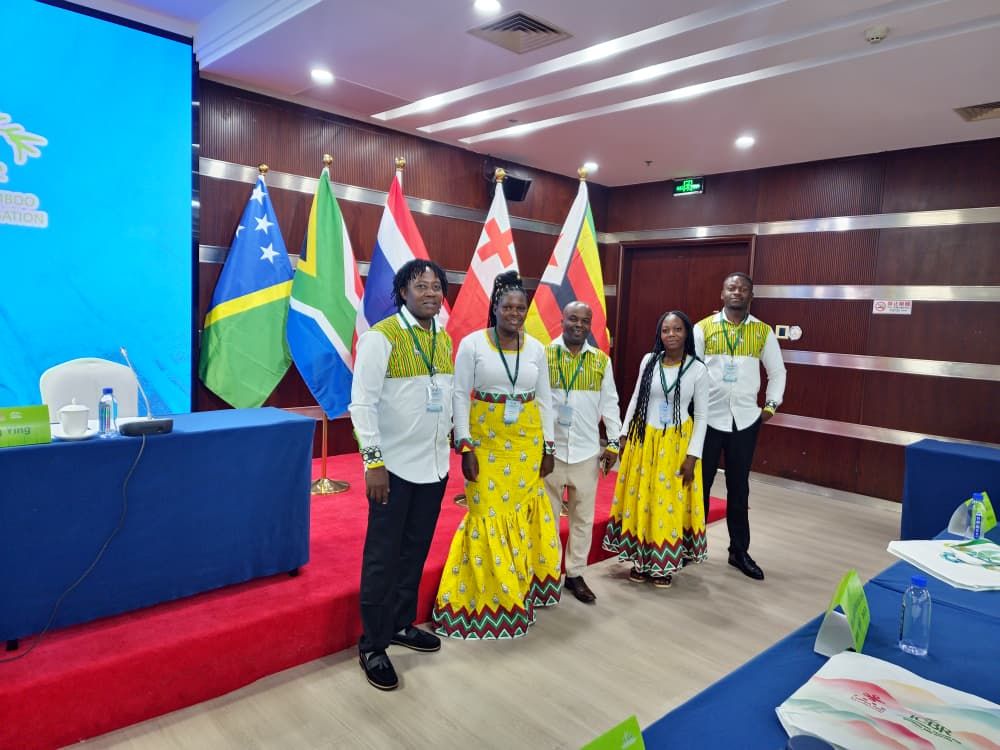
We are writing this from Beijing, where we are midway through a two-week seminar on Bamboo and Rattan Innovation Technology for Developing Countries—a programme hosted by the International Centre for Bamboo and Rattan (ICBR) under China’s Ministry of Commerce, with the support of the International Bamboo and Rattan Organisation (INBAR).
Together with delegates from Kenya, Rwanda, South Africa, The Gambia, Moldova, Thailand, Tonga and the Solomon Islands, we are witnessing first‑hand the scale of what China has achieved with a plant most Zimbabweans barely notice.
And what we have seen has changed how we think about our own country’s future.
The Global Imperative: Why Green Economies Matter
The United Nations defines a green economy as “one that results in improved human well‑being and social equity, while significantly reducing environmental risks and ecological scarcities”—in short, low‑carbon, resource‑efficient and socially inclusive.
This vision lies at the heart of the 2030 Agenda for Sustainable Development, whose 17 Sustainable Development Goals (SDGs) recognise that ending poverty must align with strategies that build economic growth while addressing climate change, responsible consumption, and the protection of life on land and below water.
Why does this matter, now more than ever? Global average temperatures continue to rise, extreme weather events are becoming more frequent, and the window for meaningful climate action is narrowing. SDG 13 calls for urgent measures to combat climate change and its impacts—but action cannot wait for distant deadlines.
Every fraction of a degree of warming translates into real losses of lives, livelihoods and ecosystems. Transitioning to a green economy is no longer an idealistic aspiration; it is a survival strategy.
At the same time, we face a parallel crisis: plastic pollution. Global primary plastic production is projected to rise 52 percent from 450 million metric tonnes in 2025 to 680 million metric tonnes by 2040. Currently, approximately 130 million metric tonnes of plastic pollute the environment every year—on land, in the air and in our waters—and without ambitious action, this figure is projected to rise to 280 million tonnes annually by 2040.
Over 400 million tonnes of plastic are produced globally each year, and an estimated 8‑11 million tonnes of this enters the ocean annually. Once there, it does not simply disappear. It fragments into microplastics, contaminating the food chain, poisoning marine life and eventually finding its way onto our dinner plates.
Zimbabwe is not exempt. The country generates roughly 300,000 tonnes of plastic waste each year, making up close to 18 percent of our total solid waste. Our own tourism jewel, Victoria Falls—a Ramsar‑listed wetland and UNESCO World Heritage Site—is choking on single‑use plastic bottles.
Wildlife, including elephants, have been found ingesting plastic, and waterways are becoming clogged. The Government has taken steps, including restrictions on thin plastics under 30 microns and a ban on polystyrene packaging, but these measures alone cannot solve a crisis rooted in the very materials our economy depends on.
The question is not whether we need alternatives to plastic. The question is what those alternatives should be—and who will provide them.
China’s Answer: The Bamboo as a Substitute for Plastic Initiative
In 2022, China and INBAR jointly proposed the “Bamboo as a Substitute for Plastic” Initiative—a bold, far‑sighted strategy to reduce pollution and carbon emissions by replacing non‑biodegradable plastic products with bamboo across multiple sectors of the economy.
Within months, the initiative was listed on the outcome document of the Global Development High‑level Dialogue. In 2023, China’s National Development and Reform Commission and three other government agencies issued a three‑year action plan to accelerate its implementation, setting clear targets: by 2025, the added value of main bamboo‑substitute products would increase by more than 20 percent compared with 2022 levels, while the comprehensive utilisation rate of bamboo materials would rise by 20 percentage points.
The plan also called for building five to ten demonstration bases in bamboo‑rich regions to promote substitution, alongside campaigns to boost innovation, connect production with sales, raise public awareness and deepen international cooperation.
Crucially, the Chinese government backed this ambition with real resources. Central budget investment of 900 million yuan (approximately US$125 million) provided a solid foundation for full‑chain development of the bamboo‑substitute industry, while an official product catalogue and standard system were rapidly expanded.
Today, China has a comprehensive “Bamboo as a Substitute for Plastic” standard system covering nine major categories—from engineering and building materials to agricultural supplies, medical products, furniture, electronics casings and daily necessities—comprising 140 separate standards.
This is not symbolic policymaking. It is an industrial strategy executed with precision.
Why This Initiative is Brilliantly Far‑sighted
China’s foresight lies in recognising that substitution must happen before the plastic crisis becomes irreversible. While the world debates treaties and targets, China is already manufacturing solutions at scale.
Bamboo is ideally suited to this task. A fully biodegradable biomass material, bamboo matures in just three to five years—a fraction of the time required for most hardwoods—and can be harvested annually without replanting. It is highly durable, renewable, and boasts an extraordinary carbon sequestration capacity.
One hectare of Moso bamboo, a species widely cultivated in China, sequesters more than 40 tonnes of carbon dioxide annually. That is not just a substitute for plastic; it is an active tool for climate mitigation.
The economic results speak for themselves. In 2025, China’s bamboo industry achieved an annual output value of over 520 billion yuan (approximately US$74.4 billion), with more than 15,000 types of bamboo products available. The country now has over 10,000 bamboo processing enterprises, supporting employment for more than 29 million people along the entire industrial chain.
China contains nearly 8 million hectares of bamboo forests, producing 150 million tonnes of bamboo annually. Sichuan and Fujian provinces have each surpassed 100 billion yuan (US$14 billion) in annual bamboo industry output, while Chishui City in Guizhou Province—once a poor mountainous region—now hosts over 200 bamboo enterprises producing everything from eco‑friendly tableware to medical swabs, with a local bamboo industry worth over 10 billion yuan (US$1.44 billion) supporting 165,000 bamboo growers.
And the scale of substitution is expanding. Bamboo is now being used to replace plastic in packaging, building materials, agricultural films, disposable cutlery, electronic product casings and even automotive interiors.
Lenovo, the global technology giant, has used bamboo‑fibre packaging for its laptops since 2008, reducing packaging material usage by 4,537 metric tonnes. Chinese companies are producing bamboo keyboards, bamboo speakers, bamboo car interiors and bamboo wind turbine blades. In 2025 alone, the bamboo winding industry achieved a total carbon reduction of 170,000 tonnes.
China’s goal is even more ambitious: by 2035, the total output value of the country’s bamboo industry is expected to exceed one trillion yuan (approximately US$140 billion).
This is what happens when a nation commits to replacing a problem material with a regenerative solution—and pursues that goal with systematic, patient determination.
What Zimbabwe Can Learn
Zimbabwe is not China. But we do not need to be. What we need is the willingness to learn, adapt and begin.
First, we must recognise that bamboo is already here. Both naturalised and indigenous bamboo species grow across our country—in the Eastern Highlands, along the Great Dyke, and along watercourses from Honde Valley to Mazowe. Unlike many other countries that would need to import and trial exotic species, Zimbabwe already has a bamboo resource base. It is currently unmanaged, undervalued and largely ignored—but it exists.
Second, we must look at bamboo not as a poor substitute for timber, but as a distinct raw material with unique properties for distinct markets. Bamboo can be processed into engineered flooring, laminated construction materials, high‑quality paper pulp, activated charcoal, textiles, furniture and an expanding range of “plastic‑substitute” products.
Global demand for these goods is rising rapidly, driven by exactly the environmental concerns we have described. Zimbabwe could position itself as a regional supplier of bamboo‑based alternatives to plastic—not only serving our domestic market but also exporting to neighbouring countries within the Southern African Development Community (SADC) and beyond.
Third, we must move beyond sporadic planting to systematic industrial development. China did not succeed because of lucky weather. China succeeded because it created bamboo research institutes, training centres, farmer cooperatives, processing hubs and export channels. It standardised planting techniques, invested in processing technology and aligned its industrial policies behind a clear national goal. Zimbabwe does not have to replicate every institution. But we do need to adopt the mindset: organisation, value addition and patience.
Fourth, we must embrace partnerships, investors and innovation as drivers of development. Zimbabwe’s path to bamboo industrialisation will not be financed entirely by domestic resources. We need to attract investors who understand the long‑term value of bamboo value chains. We need to partner with institutions like INBAR and the ICBR, which have trained over 2,600 participants from 87 countries through 76 international training programmes.
We need to access technology transfer and capacity‑building programmes offered under South‑South Cooperation frameworks, such as the China‑Africa Bamboo Centre project, which promotes cooperation on bamboo and rattan sectors including the Bamboo as a Substitute for Plastic Initiative itself.
And we need to take the first step: formal accession to INBAR. Membership would open doors to training for our officials and technicians, technology transfer and expert advice, assistance with project development and fundraising, and support for value chain development and standards implementation. Zimbabwe’s government has shown willingness to explore green industrialisation pathways. The bamboo opportunity aligns perfectly with this national direction.
A First‑Hand Account from Beijing
We are attending this seminar at an important moment—both for the global bamboo movement and for Zimbabwe’s potential place within it. The 2026 seminar, which runs from 4 June to 17 June, brings together 31 delegates from nine countries, with Bamboo Zimbabwe proud to be among them.
The course has been meticulously designed to provide not just theoretical knowledge but practical exposure: bamboo resource assessment, plantation management, processing technology, product development, standardisation, trade and the policy environment that supports industrial growth.
We have visited bamboo processing facilities, studied China’s successful county‑level bamboo economies, and discussed how these models might be adapted to African conditions. We have learned that bamboo can be a vehicle for poverty reduction—lifting entire villages out of subsistence—and a platform for climate action, all at once. And we have seen, with our own eyes, that the Bamboo as a Substitute for Plastic Initiative is not a slogan. It is a working industrial reality.
As representatives of Zimbabwe at this seminar, we are also grateful to our own Government, whose open‑door policies on international cooperation have made it possible for us to be here.
The Second Republic has consistently emphasised leaving no one and no place behind, and that vision includes enabling private‑sector actors like Bamboo Zimbabwe to seek out and bring home the knowledge our country needs to build a new economy.
Conclusion: From an Open Secret to a National Strategy
China’s bamboo story did not begin with the 2022 initiative. It began with a recognition—decades earlier—that a fast‑growing, regenerative plant could be harnessed for industrial development. And it proceeded step by step: research, pilot projects, farmer training, enterprise development, supportive policies, global partnerships and patient scaling.
Zimbabwe’s bamboo resource remains an open secret. It is growing in our backyards, along our rivers and in our highlands. We have the land, the climate and the workforce. We have a government committed to green industrialisation. And we have, at this very moment, representatives on the ground in Beijing, learning directly from the world’s most successful bamboo economy.
What we lack is not the resource. What we lack is the decision to act.
China has shown us what is possible. The Bamboo as a Substitute for Plastic Initiative has demonstrated that environmental responsibility and economic growth are not opposites—they can be the same thing. For a country like Zimbabwe, facing both the urgent threat of climate change and the daily reality of plastic waste, bamboo offers a way forward that is practical, proven and profoundly hopeful.
The path is not short. But the first step is simple: plant bamboo, process bamboo, and build an industry that serves our people and our planet.
That is the lesson we are carrying home from Beijing.
Tinashe Chidau and Tachaona Kamikani are, respectively, Executive Director and Chairman of Bamboo Zimbabwe, currently attending the ICBR Seminar on Bamboo and Rattan Innovation Technology for Developing Countries in Beijing (4–17 June 2026).
 News Sport Online