
By Tendai Chisiri
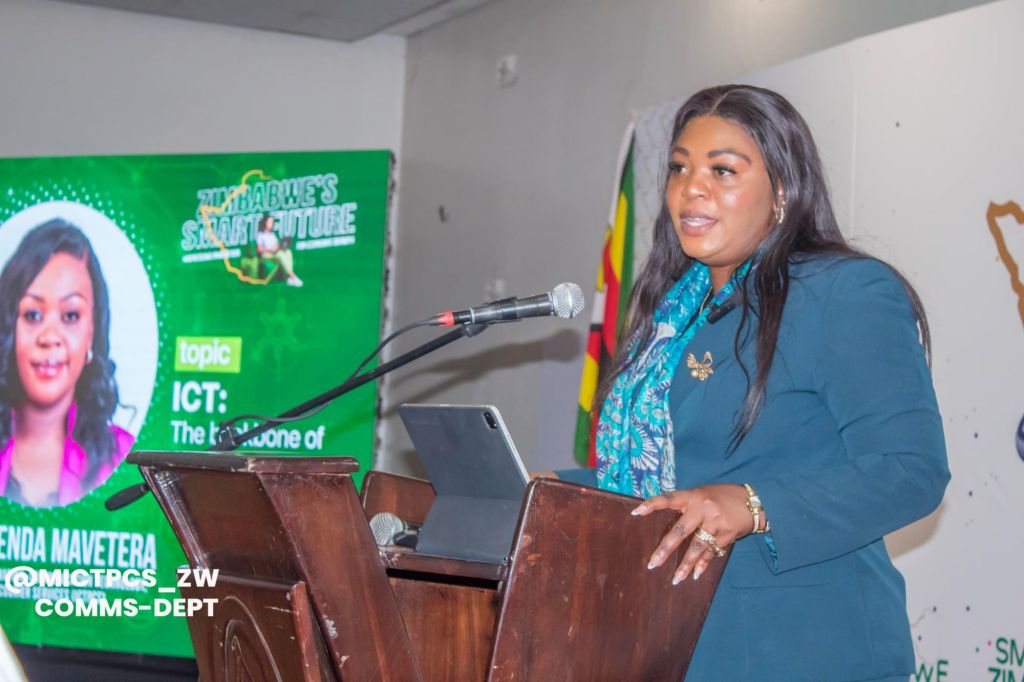
ICT is the backbone of Smart Zimbabwe, the foundation that empowers every individual, every business, and every community to be part of a connected, efficient, and sustainable future says ICT, Postal and Courier Services minister Dr Tatenda Mavetera.
Speaking recently the inaugural inaugural Smart Zimbabwe Conference and Expo, under the theme, “Zimbabwe’s Smart Future: Harnessing Innovation for Economic Growth.”, minjster Dr. Mavetera reviewed the Smart Zimbabwe 2030 Master Plan launched by His Excellency President Emmerson Mnangagwa this year in August.
“Allow me, first and foremost, to applaud His Excellency, the President of the Republic of Zimbabwe, Cde Emmerson Dambudzo Mnangagwa, for his visionary leadership in guiding our nation toward a digital transformation. It is through his foresight that we embark on this journey of building a Smart Zimbabwe by 2030”, she said.
“Digital technologies must go beyond the use of ICT for social media and entertainment. We must use the infrastructure that my Government is putting in place to improve service delivery in healthcare, education and agriculture, among many other aspects”‘ said President ED Mnangagwa at Somabhula, 7 March 2024 on the launch.
“At the heart of this transformation is Information and Communication Technology—the backbone of a Smart Zimbabwe. ICT is not merely a tool; it is the driving force that underpins every aspect of our development as a modern, competitive, and connected nation. Through ICT, we unlock the potential of data, connectivity, and automation to elevate our country’s capabilities, strengthen our economy, and improve the quality of life for all Zimbabweans”, Dr Mavetera added.
ICT infrastructure provides the digital foundations for a smart nation, from broadband and 5G networks to cloud computing and artificial intelligence. This backbone connects rural villages to urban centers, enables efficient public services, supports our financial systems, and fuels innovation. In short, ICT is the invisible force shaping our nation’s economic growth and social progress.
“Meanwhile, the Smart Zimbabwe 2030 Masterplan is set to see us achieve more creative societies, through the use of technology. The quality of life of all our people is expected to improve by the use of information and communication technologies”, added President ED Mnangagwa at Somabhula, 7 March 2024 on the launch.
“On 7 March 2024, His Excellency, the President of the Republic of Zimbabwe, Cde Emmerson Dambudzo Mnangagwa, launched the Smart Zimbabwe 2030 Master Plan, a comprehensive strategy that lays out our nation’s strategy to see Zimbabwe attain a smart nation status by the year 2030. The Pillars of the Smart Zimbabwe 2030 Master plan set out the role of ICT in transforming Zimbabwe towards Vision 2030 while ensuring that no one and no place is left behind. Allow me to briefly summarise some of the pillars:
Smart Cities: Through ICT, our cities become digitally enabled ecosystems. IoT sensors, data analytics, and smart grids allow for efficient city management—improving resource allocation, enhancing safety, and creating a more sustainable urban environment.Smart Transport: ICT facilitates modern, sustainable transport systems. Real-time traffic data, automated vehicles, and electronic ticketing systems powered by ICT make transportation safer, faster, and more eco-friendly, directly impacting our economy and mobility.
Smart Agriculture: Digital agriculture leverages ICT tools like precision farming, satellite data, and mobile connectivity, enabling farmers to make data-driven decisions. This optimizes yields, reduces waste, and supports food security—ensuring agriculture remains a key driver of our economy.
Smart Mining: ICT allows us to operate more safely and efficiently in our rich mining sector. Technologies like autonomous equipment, remote monitoring, and data analytics bring improvements in productivity and safety, making the mining sector more resilient and sustainable.
Smart Tourism: With digital platforms and virtual experiences, ICT makes Zimbabwe’s unique tourist offerings more accessible and attractive. Digital marketing, online bookings, and mobile tourism apps ensure that visitors experience the best of our nation, enriching Zimbabwe’s global tourism footprint.
Smart Health: ICT transforms healthcare through telemedicine, electronic health records, and digital diagnostics. By connecting patients to healthcare providers and facilitating remote treatments, we improve accessibility, enhance patient outcomes, and ensure a healthier population.
Smart Trade and Commerce: Digital commerce platforms, e-payment systems, and online marketplaces, all powered by ICT, enhance trade efficiency, open new markets, and provide SMEs with greater opportunities to compete and grow, driving economic resilience.
Smart Government: A responsive government relies on ICT to deliver public services efficiently. E-governance platforms reduce paperwork, increase accessibility, and build citizen trust—creating a government that is agile, transparent, and accountable.
Smart Education: With e-learning platforms, virtual classrooms, and digital content, ICT enables access to quality education for all Zimbabweans. By supporting digital literacy and STEM education, we prepare the next generation for a world defined by technology and innovation”, ICT minister explained.
“It is clear from the above summary that ICT is the backbone of Smart Zimbabwe. Today, as we gather with stakeholders across sectors, let us remember that the journey to a Smart Zimbabwe is not possible without the full integration of ICT. This is the backbone, the foundation that empowers every individual, every business, and every community to be part of a connected, efficient, and sustainable future”, she reiterated.
“A key enabler of all smart solutions is connectivity. There can be no smart Zimbabwe if we have no access to quality and affordable connectivity that is available and accessible for everyone. Government is committed to improving access to connectivity across the length and breadth of Zimbabwe. We are grateful to His Excellency, the President of the Republic of Zimbabwe, Cde Emmerson Dambudzo Mnangagwa, for expanding our basket of connectivity options through authorisation of low earth orbit satellite technology to complement the existing fibre network”, she emphasised.
She said in her speech, connectivity must be complemented by other infrastructure such as data centers and private clouds that allow us to locally host our data in Zimbabwe. She went on to say there is also a need to ensure that smart solutions and devices are affordable because connectivity without devices is meaningless. Furthermore, she challenged both the private and public sector to come up with solutions to promote access to affordable smart devices with the assurance that Government is ready to support such initiatives. “We are equally aware of the importance of skills and capacity building to ensure that all our people can safely and effectively interact with smart solutions”, she stated.
“As we focus on the attainment of a Smart Zimbabwe we must be alive to how Government itself must also become a Smart Government. In the quest for a Smart Zimbabwe, the integration of Information and Communication Technology (ICT) into governance is essential. E-governance initiatives will transform how public services are delivered, making them more accessible and efficient. By leveraging ICT tools, governments is working on fostering greater transparency in their operations, thereby building trust with citizens. This shift not only empowers residents to participate in governance but also holds officials accountable for their decisions and actions”.
” As Zimbabwe pursues a more connected future, it is crucial to prioritize the development of these ICT driven governance models. This not only addresses governance challenges but also sets a foundation for the next phase of development: the role of data analytics in decision-making processes, which will further propel the vision of a Smart Zimbabwe”, she implored.
The Government is in this regard walking the talk with active efforts being made to digitalise all Government services and to roll out smart concepts in education, health, agriculture, local government and policing among others. From a policy level, Government is also seized with consultations on national policies that govern the roll out of technology that is key to the attainment of the Smart Zimbabwe master-plan.
“We have for instance completed our AI Policy Framework and we are set to finalise our draft National Cyber Security Policy in the next few weeks. These policies are crucial to our ability to provide adequate guidelines on our interaction with ICTs and will complement existing laws and regulations under the ambit of Postal and Telecommunications Act as well as the Cyber and Data Protection Act”, Dr Mavetera revealed.
Quoting from a African Proverb from Congo “A single bracelet does not jingle.” she warned that the task of building a smart Zimbabwe is not for Government alone with the private sector having a key role to play as well. “Our nation’s path to 2030 calls for collaboration across sectors, investment in ICT infrastructure, and a collective commitment to innovation. The Smart Zimbabwe Conference and Expo provides the platform to foster these connections and deepen our understanding of how to harness ICT for economic growth”, she said.
 News Sport Online