
By Tendai Chisiri
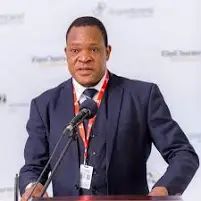
Zimbabwe undertook a transformative land reform programme more than twenty-three years ago which ushered in 23 000 A2 and 360 000 A1 farmers and agricultural training instutions need to be the foundation for the various beneficiaries says minister of Lands, Agriculture, Fisheries, Water and Rural Develooment (MoLAFWRD) Dr. Anxious Masuka.
The minister was represented by his deputy Davis Marapira at the graduation ceremony of 126 students at Esigodini Agricultural Training College. He said perhaps over 90% of these farm beneficiaries are non-agriculturalists and thec Agricultural Training Institutions ought to be the foundation upon which these various farm beneficiaries will get the much-needed skills for this “newly found” occupation.
“I am honoured to be your Guest of Honour at this important occasion on the annual calendar of Esigodini Agricultural Training College. This graduation ceremony marks another milestone on our Agricultural Education transformation journey. We are gathered here not only to acknowledge, appreciate and celebrate the achievement of this college’s 2024 final year students but also as a reconfirmation of the Second Republic’s unwavering commitment, under the astute and visionary leadership of our President, His Excellency Dr. E.D. Mnangagwa, to develop our youth, who in themselves are an important demographic segment, as we journey towards Vision 2030”, he said.
Government made agriculture and food security a priority under the National Development Strategy 1 hence the ministry’s Mantra, Food Security: Everywhere, Every day.”For this to be achieved and sustained, our agricultural training institutions need to align with this thrust”, Dr Masuka explained.
Erratic rainfall driven by climate change, a case in point being the 2023/2024 season El Nino-induced drought, poor access to finance, logistics and storage problems, dislocated markets, a changing rural demography, among many factors, have led to perennially low production and low productivity. This has been compounded by a rigid education system that has not responded to the versatile requirements of the new creed of farmers, from smallholder, A1, small scale, A2 to large scale farmers.
Vision 2030 of an empowered and prosperous upper middle-income society, eloquently enunciated by the President, His Excellency, Dr E.D. Mnangagwa, requires a new education paradigm as agriculture is at the core of rural development and rural transformation to power the improvement of livelihoods.
Dr Masuka is delighted that, in line with the Agricultural Education for Development 5.0 curriculum, the Agricultural colleges have been transformed to move away from the old system of producing “trainers and extensionists” to produce graduates perfectly suited for this new need, focusing on the production of farmer-centric and business-oriented advisory service graduates, for a new land reform dispensation, steeped in the college’s display of unique entrepreneurial excellence, radiating into the surrounding communities, and acting as epicentres of agricultural transformation.
The new Agricultural Education for Development (AE4D 5.0) system focuses on five objectives:
Training – imbuing contextual, relevant, practical and quality understanding of the fundamentals and practice of agriculture. This is essentially training trainers.
Business Advisory – concentrating on inculcating confidence and values of agriculture as a business, and agriculture as an art and a science, while instilling a sense of urgency in graduates as the agents of overdue transformation of rural subsistence households to rural commercial households, A1 farmers to SMEs and A2 farmers to businessmen and business women.
Research – elevating thinking processes and self-esteem, cultivating independent problem-based learning, applying novel technologies and processes to modernize agriculture, and creating graduates capable of intervening at any part of the agricultural value chain to transform production, productivity and profitability.
Innovation – cultivating constant enthusiasm for discovery-led progress, illuminating and enlightening vistas of potential improvement to ensure profitability and sustainability in agri-businesses.
Entrepreneurship – being twofold with a (i) focus on generating sufficient resources to sustain the college as both a learning and business centre and (ii) creating graduate entrepreneurs capable of transforming agriculture, enabling graduates to set up and manage agricultural enterprises, creating employment and adapting to the dynamic agricultural landscape and changing value chains.
He pleased to note that the current graduating class of one hundred and twenty-six (126) students, comprised of a balanced ratio of 68 females and 58 males, is a product of this transformative new curriculum focused on agricultural education for development.
The Government has capacitated all the eight Agricultural Colleges with tractors and motor cycles for student training.
The transformation of livelihoods for the attainment of Vision 2030 that the ministry seek is based on an agro-centric approach to development as over 70% of the population is involved in agriculture.
He highlighted the strong “agricultural development-rural industrialisation-rural development-vision 2030 nexus”, anchored on the indisputably correct observation that “development originating from the agricultural sector is twice as powerful at lifting people out of poverty than development emanating from other sectors”, and that “no country has transitioned from a low-income economy to a middle or upper middle-income economy without increasing agricultural productivity”.
Rural Development 8.0 comprises a series of outcome and impact-based Presidential Schemes such as (1) the Presidential Climate-Proofed Input Scheme, (2) the Presidential Cotton Scheme, (3) thePresidential Blitz Tick Grease Scheme, (4) the Presidential Rural Development Programme, (5) the Presidential Community Fisheries Scheme, (6) the Presidential Poultry Scheme, (7) the Presidential Goat Scheme and (8) Vision 2030 Accelerator Model. These outcome-based interventions directly impact the attainment of Vision 2030 as causes, co-factors, accelerators and multipliers.
In light of the President’s pronouncement that no household and no village should be left behind as we march towards Vision 2030, I am pleased to note Esigodini Agricultural College’s thrust of helping train youths and farmer field schools under various programmes that are supported by the Zimbabwe Agriculture Development Trust (ZADT) and the United Nations Development Programme (UNDP) initiatives respectively to enhance their capacities in agricultural development.
The Ministry has established Provincial Youth Integrated Agricultural Development Centres to act as incubators for Youth training in agriculture. Zimbabwe Online Agricultural College (ZOAC) will complement this effort. Graduate internships are central to training so partnerships with farmers should be enhanced.
 News Sport Online