
By Tendai Chisiri
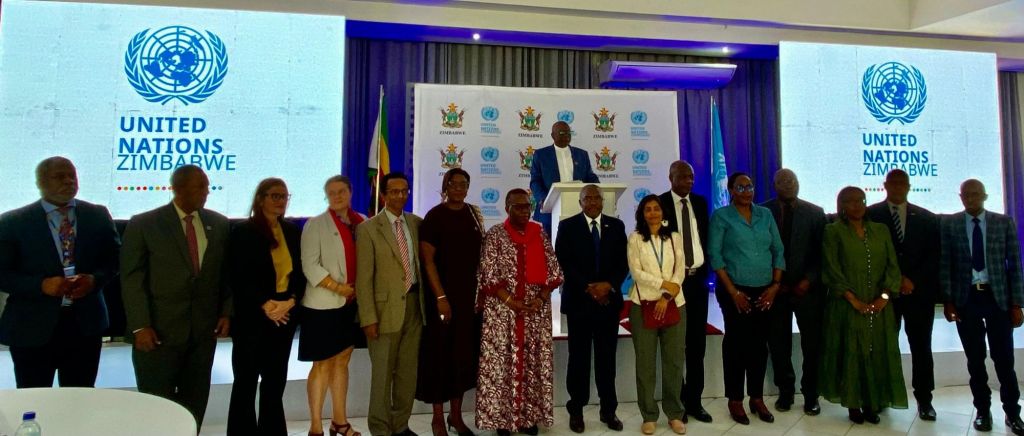
Giving remarks on the Mid Term Review of the 2022-2026 Zimbabwe UN Sustainable Development Cooperation Framework, UN resident and humanitarian coordinator Mr Edward Kallon reveals that UN disbursed USD1. 2 billion for UN supported development programmes and humanitarian efforts in Zimbabwe.
UN resident and humanitarian coordinator MrEdward Kallon revealed this whilst thanking the development partners and donors for their generous financial contributions. ” I extend my heartfelt gratitude to our development partners and donors for their generous financial contributions, which make up more than 90% of the funding for UN supported development programmes and humanitarian response efforts in Zimbabwe. For instance, out of the over USD 1.2 billion disbursed in the past two years and half, joint programmes contributed approximately USD 160 million. This includes the USD 90 million Health Resilience Fund and the USD 9.5 million ZIM-ECO2 project, underscoring your critical role for UN agencies to work together”, he said.
”To our partners in NGOs, CSOs, youth groups, academia, media, and the private sector, such as ZNCC, CZI, Old Mutual, and Econet, thank you for your ongoing engagement and commitment to actualizing the Cooperation Framework’s vision. Your support and insights are invaluable”, he added.
”To my UNCT colleagues, thank you for embracing UN reform and the “four-ones” approach—One Programme, One Leader, One Budgetary Framework, and One Office. We are progressing with initiatives like the UN Common Back Office and reviving the UN Partnerships and Development Finance Task Force” Kallon said.
Despite joint progress, Zimbabwe still confronts significant development challenges. The latest SDG index highlights the need for tailored solutions to address poverty, economic growth, inequality, climate change, disaster risk management, and institutional strengthening.
Kallon said the secretary-general has emphasized six key transitions as investment pathways for accelerating SDG progress: food systems, energy access, digital connectivity, education, jobs and social protection, and climate action.
”Integrated, cross-cutting policies are essential to advance these transitions. To enable these shifts, we must work together to: first, establish policy and regulatory frameworks, adopting the Government of Zimbabwe’s whole-government, whole-society approach. Second, identify and develop scalable “bankable and market-ready” national projects.Third, develop development financing consistent with the recently ECOSOC-endorsed country-level funding compact for the Cooperation Framework to promote synergy and support speedy implementation of development programmes.Fourth, invest in building the capacity of public institutions and civil society organizations to enhance their role in executing the six transitions”, he revealed.
The United Nations System in Zimbabwe remains committed to work with the Government of Zimbabwe and all stakeholders to facilitate these transitions in the country.
The Cooperation Framework transcends being merely a blueprint for UN-funded activities in the country. It is: First, Strategic Guide: It directs the planning and execution of UN development initiatives, supporting Zimbabwe’s pursuit of the 2030 Agenda for Sustainable Development and informing national policy as the country pursues its national development aspiration.
Second, UN Compact/Value Proposition for Zimbabwe: It brings together the technical expertise, mandate and comparative advantage of 25 UN entities, collaborating to deliver tangible development results in support of Zimbabwe’s National Development Strategy 1 (NDS1), Vision 2030 aspirations to become an upper-middle-income country, and the Sustainable Development Goals (SDGs).
Third, Strategic Partnership Platform: It fosters inclusive dialogues and partnerships, adhering to the Common Minimum Standards of Multi-Stakeholder Partnerships. This platform leverages sustainable financing, encouraging investments towards realizing the 2030 Agenda. It supports channeling donor contributions and developing innovative financing strategies for collective development results that leaves no-one behind.
 News Sport Online