
By Tendai Chisiri
The amount of precipitation, type and occurence is mainly determined by atmospheric temperature, pressure is also a factor, while wind speed and direction are the two other important factors including the charecteristics of the land.
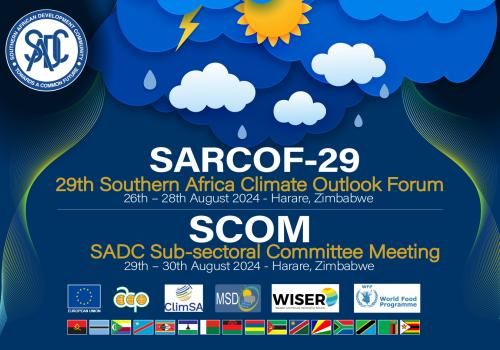
The Secretariat of the Southern African Development Community (SADC), through the ClimSA programme, which is financially supported by the European Union (EU) funded through the Intra-ACP Climate Services and related Application (ClimSA) Programme, hosted the Climate Outlook Forum (SARCOF-29) on 26th – 28th August 2024 in Harare and will host the SADC Sub-sectoral Committee Meeting (SCOM) on Meteorology on 29th – 30th August 2024 also in Zimbabwe.
These meetings are integral to the implementation of the Global Framework for Climate Services (GFCS) in the SADC region. The GFCS aims to strengthen and coordinate the development, delivery, and use of climate services to support decision-making in addressing climate-related risks at national, regional, and global levels.
These meetings take place against the backdrop of the SADC region’s call for a Regional Humanitarian Appeal to assist Member States affected by the El Niño-induced Drought and Floods, as well as other climate challenges such as low rainfall, increased frequency of floods, cyclones, and droughts.
Aligned with the SADC Regional Indicative Strategic Development Plan (RISDP) 2020–2030, which emphasises the integration of environmental considerations into socioeconomic development activities, the meetings deliberates on initiatives and strategies to enhance the sustainable use and management of the environment in the fight against poverty and food insecurity through climate services.
The SARCOF, held biannually, plays a crucial role in identifying climate variability patterns for the season, evaluating the past season and issuing an outlook for the upcoming rainfall season.
This forum brings together climate service producers and key stakeholders from sectors including the Water, Energy, Food and Agriculture, Health and the Disaster Risk Reduction to deliberate on the implications and mitigation strategies for upcoming rainfallseason to concurrently co-develop an early warning advisory for the region which contributes to climate-driven decision-making for policy and operational users.
The theme for SARCOF-29 is; “At the frontline of climate action towards improved climate services”.
The official statement from SARCOF-29 read by Meteorlogical Services Department Zimbabwe (MSD) director Mrs Rebecca Manzou highlights that bulk of the SADC Region is likely to receive normal to above normal rainfall for most of the period of October to December 2024 including Mauritius and Central Madagascar, apart from north-western part of Democratic Republic of Congo, where above-normal rainfall is expected.
” The remainder of the region is likely to receive normal to below normal rainfall for most of the region expect for the south-western fringes of South Africa, south-eastern and western most of DRC, north-western Angola, Tanzania, northern Zambia, northern Malawi, northern Mozambique and central western tip of Madagascar where normal to below-normal rains are expected including Comoros and Seychelles.
Northern Madagascar is likely to receive above normal rainfall during this period of the 2024/25 rainfall season”, she said.
Temperature outlook for the entire 2024/25 rainfall season are expected to be mostly above longterm averages over the whole SADC region.
The Twenty-Ninth Annual Southern Africa Regional Climate Outlook Forum (SARCOF-29) was held virtually from 26 to 28 August 2024 to present a consensus outlook for the 2024/2025 rainfall season over the SADC region.
The period of October to March is the main period of interest for this outlook for Southern Africa.
 News Sport Online