
By Tendai Chisiri
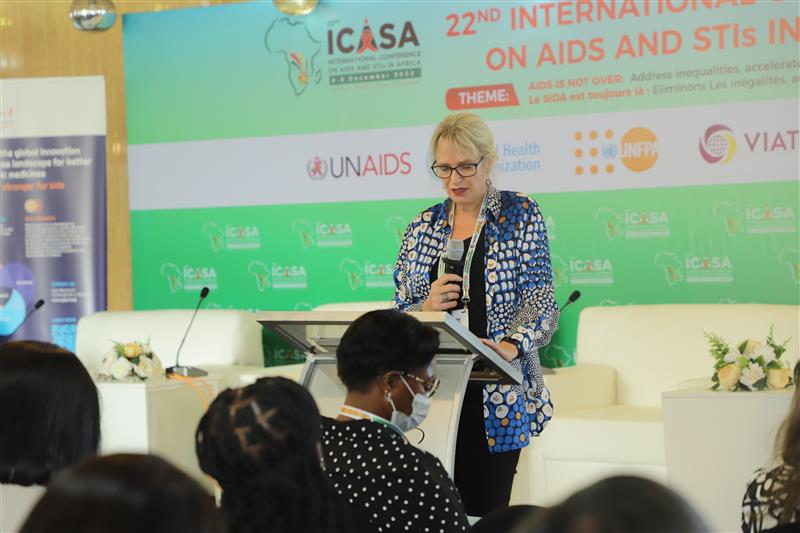
Elizabeth Glaser Pediatric AIDS Foundation (EGPAF) executive vice president Anna Giphart says children are lagging behind when it comes to case identification and viral load suppression as they die at higher rate compared to adults living with HIV/ AIDS.
In an interview with Online Now News on the sideline of the six-days 22nd International Conference on AIDS and STIs in Africa (ICASA) in Harare, Giphart said children continue to be left behind and they feel very strongly that it is their goal to pick up for the children.
“Its not that we don’t know how to treat the children or we don’t know how to identify them but we have to make sure that everybody includes them in their plans. We need to continue to improve the medical formulations because it is very difficult to treat the little children with medical formulations that are sour to them”, she said.
” Right now, globally 71% of the adults who are living with HIV are on treatment but for children that is only 50%. Children are only 4% of the persons living with HIV but they account for 13% of all the deaths. It would be 4%, but its not, its 13%. So it means children are dying more than adults. So they die disproportionately more. This is so because children are less often identified and put on treatment, they are less often virally suppressed “, she bemoaned.
It is very difficult for children to take medicines and sometimes the medical formulations are bitter so children do not want to take them. A lot of work is being done to make sure that there are other friendly drug formulations for children.
She said one of the major challenges is that children’s voices are not heard and are forgotten when people make plans. ” Children have special needs, they have a special way of diagnosing the HIV infection. You can’t use rapid test on a small baby. You have to have a special test and also have special medical formulations. So it is important that we plan well for the children as well”, she emphasized.
In Zimbabwe, EGPAF has Point of Care Early Infant Diagnosis (POC/EID). It means one can detect the virus in a child early on. “Before that, the diagnosis was only possible in central laboratory, so the mother had to go there with the child or send blood samples. That would take sometimes two months for the analysis to be done. It was also difficult for mothers to go there and come back without the results. Very often, the children would die before they get the diagnosis. So, by bringing POC/EID to the facilities where mothers were coming, to help them getting the results on the same day. Therefore, the child would be put on treatment the same day. This really saves a lot of lives”, she said.
EGPAF is fighting for an AIDS-free generation globally in children, adolescents and families. They hope that by 2030, all persons leaving with HIV/AIDS have access to medicines and live productive lives.
The organization was initiated in 1986 in United States of America by Elizabeth Glaser an American woman who got HIV infection through a blood transfusion. She unknowingly passed on the virus to her two children.
When her eldest daughter got sick, her illness led to the discovery that she had AIDS. They found out that the mother and the young brother were also infected. In the early days of the pandemic in USA, there was no focus on children with HIV. The focus was very much on gays.
Glaser started the foundation with her two friends around the kitchen table literally grassroot organisation to make sure that children were also put on the agenda. With the transmission of HIV from mother to child having reduced significantly in USA, she decided to support the people in Africa.
EGPAF technical director in Lesotho, Puseletso Maja concurred with Giphart in a sideline interview that children still remain behind in the fight to end HIV/AIDS.
” Lesotho has reached the UNAIDS 2020 90-90-90 target. However, even with the results, children still remain behind and that is why it is important to continue collaborating and working effectively with the Ministry of Health so that the children get to a place where we end AIDS for them. There is still a lot of work to be done, to put the children, to find them and also to ensure they are on treatment in Lesotho “, she revealed.
EGPAF in Lesotho started in 2004. The main focus is on children and pregnant mothers. At national level, they support the Ministry of Health in terms of policy changes, development of guidelines, standard operating procedures (SOPs), job aids and participate in care work.
At district level, they have district teams, which work closely with the Ministry of Health District Teams. At the health facilities, they do have staff that provide direct service.
At community level, they work closely with Civil Society Organisations (CSOs) who are part of their sub. The CSOs they work with are Lenepha and Lenaso. The CSOs do tracking. Tracking is when they have lost a child or mother and they bring them into care and also do contact tracking. If a person is lost, the person may be on ART or HIV positive but no longer coming for medications.
“Usually it is the children who get lost. Children depend on their parents for medication. If the mother gets tired to collect the medication, the child would be lost.”, she said.
The main challenge EGPAF is facing is finding the children. ” Finding the children is very difficult because the children depend on their care givers, who are the elderly, to bring them into care . The mother would go somewhere in South Africa to work and then the child would be left with a granny. So, with the elderly, you can find out that the children are not taking their medicines because granny is forgetting the appointment nor even giving them medications “, Maja said.
” We need to engage with village care workers because at the end the mothers need to work because if they don’t work, the children get nothing. The granny is old and there isn’t anything we can do but strengthen our community models. This is where village community care workers do a more participatory role in terms of at times be able monitor the children within the community”, she added.
 News Sport Online