
By Tendai Chisiri
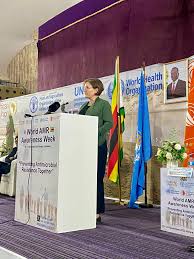
United Nations, in collaboration with the African Union and the Republic of Zimbabwe observing World AMR Awareness Week 2023, calls for enhanced political advocacy to highlight the severity of the growing AMR threat across the continent.
UN resident coordinator ad interim Ms Francesca Erdelmann in her remarks at the event extended her congratulations to the Government of Zimbabwe, and UN key Development Partners as well as the lead UN Agencies – FAO and WHO for their efforts in bringing together a wide range of partners and organizing the African week of AMR advocacy .
“AMR is a global event, taking place from 18 to 24 November each year, serves as a momentous occasion for us to raise awareness and take action against the growing threat of antimicrobial resistance”, she said.
During the United Nations General Assembly in September 2016, world leaders demonstrated their commitment to tackling AMR by declaring it a global crisis with significant implications for global health and food security.
The World Health Organization has even identified AMR as one of the top 10 global public health threats facing humanity.
“Why is antimicrobial resistance the biggest threat we face? Because drug-resistant infections pose a grave risk to our health, as well as the progress we’ve made in healthcare, food production, and life expectancy itself. Antibiotic-resistant pathogens have been found in all corners of the globe, and with the ease of modern travel, they can easily cross borders and continents”, she revealed.
“It is crucial for us to take urgent multisectoral action to address this global health and development threat. Misuse and overuse of antimicrobials are major drivers in the development of drug-resistant pathogens. Inadequate access to clean water, lack of sanitation, and insufficient infection prevention and control measures further contribute to the spread of antimicrobial-resistant microbes”, she added.
The economic cost of AMR is significant, with health complications resulting in longer hospital stays, increased expenses for medicines, and financial hardships for those affected. Without effective antimicrobials, the success of modern medicine in treating infections, including during major surgeries and cancer chemotherapy, would be at risk.
In sub-Saharan Africa, the threat of AMR primarily arises from unregulated and inappropriate use of antimicrobials across various sectors, including human, animal, and plant use. The lack of policies guiding the procurement and use of medicines has led to the proliferation of substandard and falsified drugs. These factors not only jeopardize health but also endanger several key sustainable development goals related to health, agriculture, animals, the environment, and food security.
This year’s theme, “Preventing Antimicrobial Resistance Together,” underscores the need for urgent multisectoral action under the One Health Approach to safeguard the effectiveness of antimicrobial medicines. In 2019 alone, antimicrobial-resistant infections claimed 4.9 million lives globally, surpassing the combined death toll from HIV/AIDS and malaria. Sub-Saharan African countries, with 99 deaths per 100,000 people, bear the heaviest burden of AMR-associated mortality.
The upcoming UNGA 2024 High-level Meeting on AMR will provide an opportunity to set new targets and practical steps to address AMR. Heads of Government, Government Ministers, and political leaders will gather to discuss effective approaches to combating AMR at local, national, and global levels, considering aspects such as funding, policy development, and international collaboration.
“As we observe World AMR Awareness Week 2023, the United Nations, in collaboration with the African Union and the Republic of Zimbabwe, calls for enhanced political advocacy to highlight the severity of the growing AMR threat across the continent”, Erdelmann said.
“In line with the UN strategy for implementing and monitoring national action plans on AMR, I would like to reiterate our “call to action” to Member States:
Increase and maintain domestic funding to effectively implement AMR National Action Plans.
Support the development of resilient health systems by striking a balance between addressing AMR and maintaining access to essential medicines.
Enhance surveillance and laboratory capacity to prevent, detect, and respond to AMR using existing global and regional strategies, policies, and guidelines.
Implement targeted AMR awareness campaigns nationwide, involving various sectors, to build the capacity of healthcare professionals and foster behavioral change among health workers and the community.
Foster collaboration among stakeholders, as this is paramount to successfully combatting AMR. African countries must unite in implementing tailored national action plans, sharing best practices, and coordinating efforts to enhance antimicrobial stewardship”, she said.
She urged all to continue to work together to prevent antimicrobial resistance and strive for a healthier and more sustainable future for all, leaving no one behind.
Honourable V Haritatos, deputy minister of Land, Agriculture, Water and Rural Development,Honourable Dr. T. D. Mombeshora, minister of Health and Child Care, Honourable Nqobizitha Mangaliso Ndhlovu, minister of Environment, Climate and Wildlife, Dr Agnes Mahomva, Public Health advisor to the President and Cabinet. She recently received the Order of the Star of Zimbabwe in Silver from the President for her outstanding contributions during the shared Covid-19 response and His Excellency Dr Jean Kaseya, director General Africa CDC were invited to the commemorations.
 News Sport Online