
By Tendai Chisiri
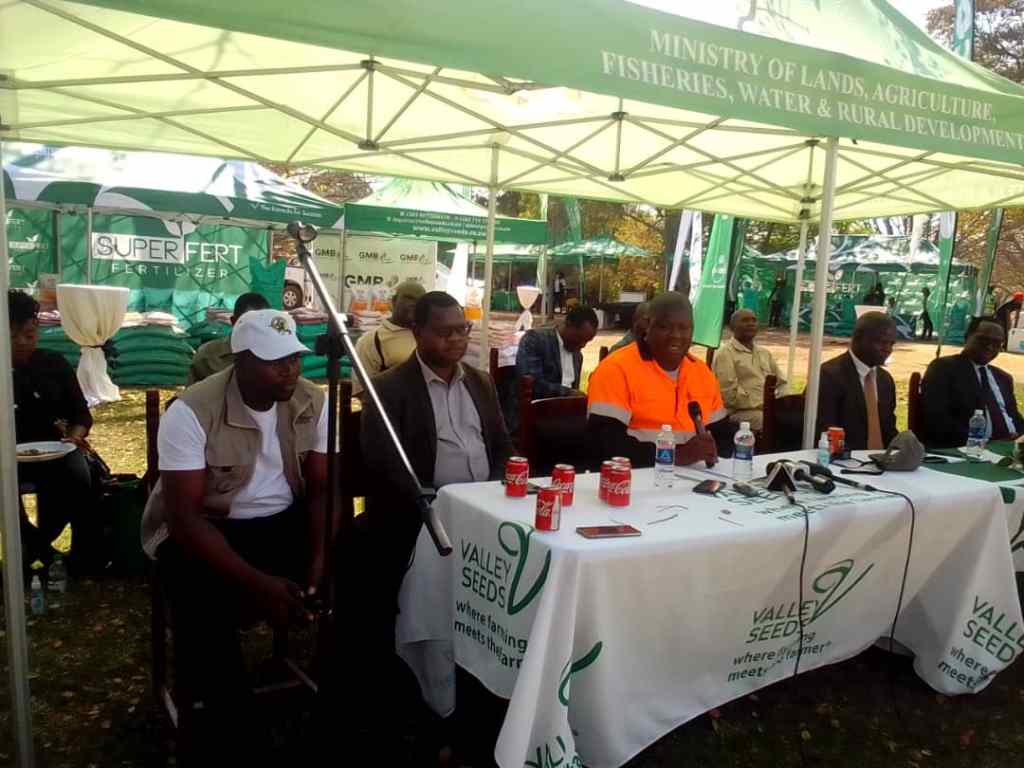
Permanent Secretary in the Ministry of Lands, Agriculture, Fisheries, Water and Rural Development (MoLAFWRD), Dr John Bhasera has commended the media for reaching out to farmers and reporting agriculture narrative as journalists par excellence.
Speaking at the agriculture journalists luncheon held at Botanic Gardens in the capital Friday, permanent secretary said the event which the ministry hosted was made possible by various agriculture stakeholders.
“We have over 50 000 farmers and the media is doing a sterling j ob in reaching out to the farmers with information. As a ministry, there is no way we would reach all the farmers that is why I see it imperative to thank the media. Our relationship as ministry with the media is sound and we urge the media to keep up the good work”, he said.
He also urged the media to prioritize writing about conservation farming with the method of Pfumvudza being the solution to mitigate El Nino which is said to occur during the 2023-24 farming season. “There is need for journalists to tell the story about Pfumvudza. We are going to have drought this farming season, so farmers should be told about how mulching helps to retain the moisture and the importance of digging holes for plants instead of tilling”, he urged.
Conservation agriculture is a farming system that promotes minimum soil disturbance (i.e. no tillage), maintenance of a permanent soil cover, and diversification of plant species. It enhances biodiversity and natural biological processes above and below the ground surface, which contribute to increased water and nutrient use efficiency and to improved and sustained crop production.
Pfumvudza is a crop production intensification approach under which farmers ensure the efficient use of resources (inputs and labour) on a small area of land in order to optimize its management. This involves precision output planting at the proper time, crop rotation (corn/beans), and deep mulching to retain moisture and keep weeds down. Nutrients are supplied by both compost and chemical fertilizers. This method can be practiced by farmers owning no tool other than a hoe. Pfumvudza allows concentration of resources on small land units thereby optimizing both natural and external resources (soil, water, inputs, labour). It also facilitates high levels of management. Can facilitate water-planting or supplementation.
“Farmers can take harvested maize stalks or dry grass and use them for mulching in order to prevent the soil moisture to be affected by intensive evaporation. The country is going to experience normal to below normal rainfall. This is not bad as the rains are normal not only below normal. However there is need to use conservation farming so that the little rains received should be well used ” he hinted.
Conservation farming does not only help to mitigate drought but it also cut costs for the farmer. For instance, if a farmer digs holes. He applies fertiliser in the holes together with the seed. This helps the farmer to use a small amount of Compound D fertiliser as the fertiliser applied would be near the plant roots unlike when the fertiliser is applied after the plant has germinated. After the plant has germinated, the farmer applies a lot of fertiliser in the latter procedure as some of the fertiliser may not reach the plant roots which would be too small at the time.
In the Pfumvudza scenario, the plant absorbs all the fertiliser although a few would have been applied. Pfumvudza is cost-effective thereby making the farmer have high yields at a low cost. After the plant has germinated, with about seven leaves on it, the farmer is now able to apply Urea fertiliser , the top dressing one. This helps the plant to fully grow if the top dressing fertiliser is used at early stages. Another top dressing of Urea fertiliser can also be applied for the plant to have good maize cobs. It is not recommended for the farmer to apply Urea late when the maize cobs are already potruding by on the maize stem as the Urea fertiliser may not have been fully taken by the plant resulting in it only making the stalk big but not making the maize cob large. Conservation farming also cut tillage costs which are very dear to many farmers especially small holder farmers.
Jonathan Gandari, chief director in the Ministry of Information, Publicity and Broadcasting Services speaking at the event said his ministries was going to work with community radios so that agriculture news is disseminated to every corner of the country.
” We will have radio programmes with information from MoLAFWRD such that there would be programmes to help farmers around the country. Agriculture is the backbone of our economy in Zimbabwe, so it should be taken seriously”, he said.
Journalists were left elated after they received a hamper of agriculture inputs each. Memory Chakwita a passionate journalist, international agricultural advocate and farmer said on the sidelines of the event “I encourage all journalists to take farming as a business, l am a maize SC 727 & horticulture farmer who is also into livestock production in Marondera. l eat what l produce at my farm”.
John Cassim a publisher, editor and journalist with a digital news platform in on the sidelines said, “Thank you permanent secretary.I received a golden birthday present there. We are going to farm this season and thank you for the started pack”. John Cassim Snr had his birthday on Saturday.
Permanent secretary John Bhasera is an award-winning permanent secretary with a vast agriculture background after having served Seedco for many years. He has almost reached the 2025 targets, registered a surplus in wheat production and is now aiming to have it exported in order to generate revenue for the country from the harvests.
 News Sport Online