
By Tendai Chisiri
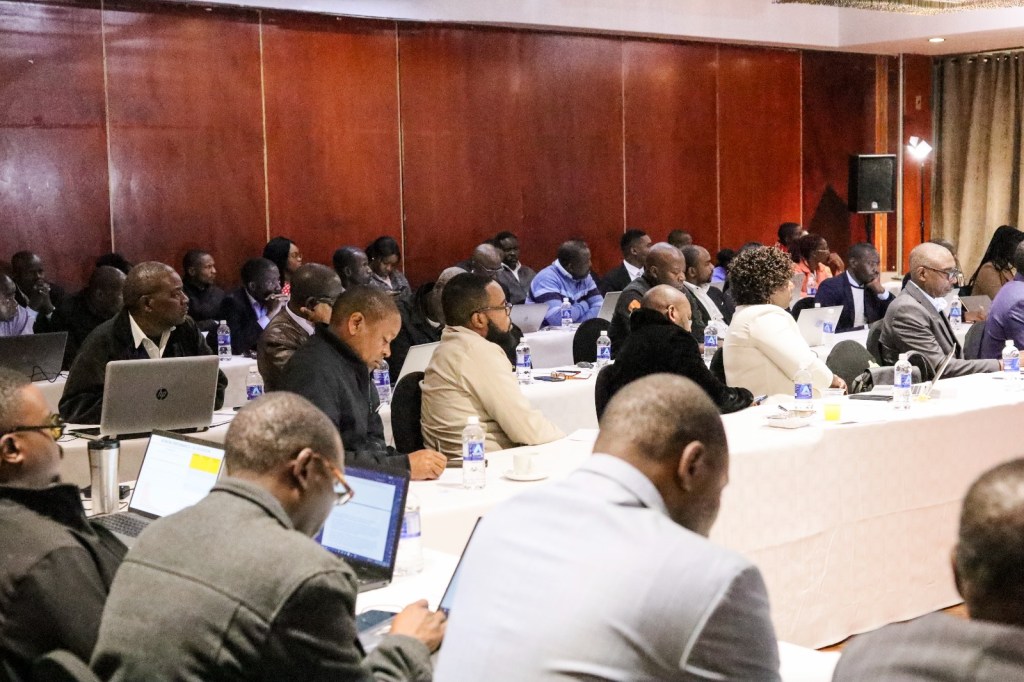
Experts attending the prepatory meeting
Postal and Telecommunications Regulatory Authority of Zimbabwe (POTRAZ director general Gift Machengete lauded communication in communities at the 3rd Zimbabwe World Radio Communications (WRC) two-day prepatory meeting held at a capital hotel.
“I would like to say it is the nature of human beings to live in commnunities, which communities are built through communication. Each of us has loved ones – some live with us and some live several hours flight away, yet we need to find a means to communicate with them if we are not to drift apart,” said Machengete.
The introduction of the Telephone by Alexander Graham Bell in 1876 opened a whole new era of realtime long distance communication which has only been refined and improved over the years.
People now talk of chats, voice notes, voice calls and video calls, most times without stopping to think, what makes these possible.
“We have gathered here today and tomorrow as Zimbabweans, to focus on that which enables our communication networks, that is Radiofrequency Spectrum, and to reimagine its possible future use in the context of WRC23 Agenda Items,” he said.
” I am happy to see that there is good representation of the various stakeholders whose business is affected by Radiofrequency usage,” he added.
“It is likely that a significant number of us are from the Mobile Communications Industry, keenly interested in when additional spectrum will be availed”.
“The Developed countries of the world have rolled out the fifth generation of mobile services (5G) and are beginning to think of the next generation. Their choice of frequencies for 5G were primarily in the millimetre bands above 20 GHz,” he expressed.
“The same frequencies are available for use in Zimbabwe and indeed in Africa, but we believe they are not cost effective for us to roll out services,” Machengete revealed.
“The frequencies which we believe to be economical are in bands below 10 GHz. However, these bands are already in use for some other services. There are four Agenda Items in the WRC23 Agenda, which aim to avail spectrum for Mobile Services in one way or another,” he added.
All of these Agenda items have many proposed methods and finding common ground will require skill in negotiating.
” We hope that this meeting can identify solutions to this dilemma, in Zimbabwe, so we can provide sufficient spectrum for services to come to par with where the developed world is,” he hlighted.
He also said the prepatory meeting is of importance to those in the Aviation Sector as they will be keen to hear that there are plans to modernise the Aeronautical Services, by implementing digital systems in the Aeronautical bands.
Digital communications have the advantage of offering clearer communication wherever one is located throughout the service area.
However, changes to existing systems present the challenge that additional investment is called for. In addition, the service area may change or other existing services may suffer interference. We are called on to carry out careful scrutiny in order to arrive at solutions that bear the most advantage.
“In Satellite Services, we are happy to report that Zimbabwe successfully filed the second part of Technical papers for a replacement Broadcast Services Satellite in accordance with Resolution 559 of WRC-19,” he revealed.
This filing and the subsequent application to WRC-23 to have the new Satellite at 16 degrees West replace the Old satellite at 0.8 degrees West, brings the country closer to restoring her satellite orbital slots to usable state.
The work on Resolution 559 is one of the many Satellite related items that we have been seized with since WRC-19.
“You may be aware of the Starlink Constellation, but there are numerous other Non Geostationary (nGSO) satellite constellations that are planned or are being launched. Without careful coordination, our planned Geostationary Satellites could soon be rendered inoperable due to interference from the nGSO constellations,” he said.
Not only this, but there could also be aspects of exposure to ElectroMagnetic Fields which may not have been well considered.
He encouraged those attending the prepatory meeting as experts, to carefully consider Agenda Items related to Satellites Services with a view for us to have an advantage.
The World Radiocommunications Conference of 2023 will take place in Dubai, from the 20th of November to the 15th of December 2023. It will be preceded by the Radiocommunications Assembly which will take place from the 13th to the 17th of November.
 News Sport Online