
By Tendai Chisiri
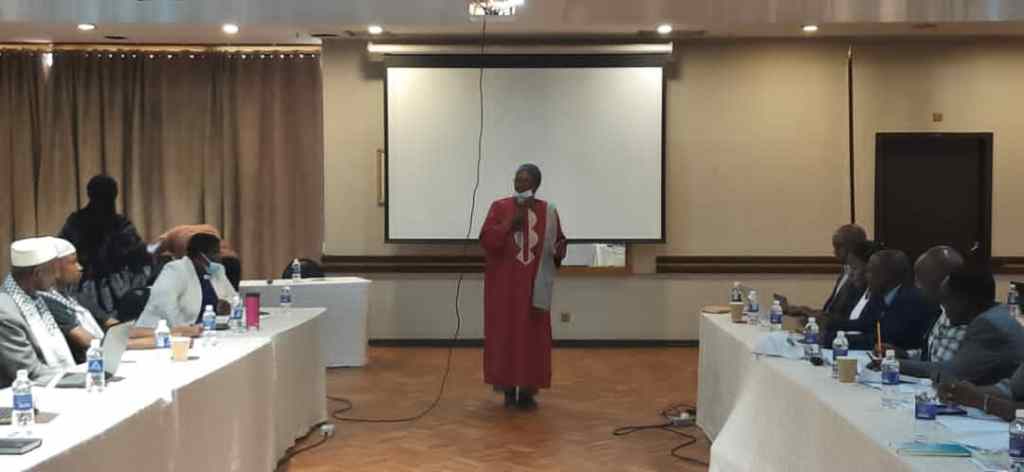
UNAIDS held a two- day Training of Trainers (ToT) workshop for Interfaith Members and Faith Based Organisation on Male Engagement in HIV/SRHR/GBV)CSE issues at a hotel in the capital on the use of toolkit and application and its further refinement as possible.
The toolkit provides key messages on Sexual Reproductive Health Rights (SRHR), Human Immuno Virus (HIV), Gender Based Violence(GBV) and Comprehensive Sexuality Education (CSE) and will be a reference for participants’ constituencies.
UNAIDS country director Sophia Mukasa Monico in her opening remarks said the idea of the toolkit was mooted in 2019.
“Since 2019, the UNAIDS country office in Zimbabwe in collaboration with the UN family and support from NAC, MOHCC and civil society partners have been building capacity for Interfaith Network leadership and middle management on male engagement for HIV, SRHR and GBV as well as comprehensive sexuality education”, said Monico.
“The need for a manual arose when the FBO network members noted that while there have been numerous varied materials on the subject areas HIV, SRHR, GBV and male engagement existing materials lacked specificity. The network therefore requested for a toolkit that would provide relevant information, key messages and reference documents for their use and that of their members”, she added.
She further stated that the training will enhance capacity of Interfaith Network Institutions to programme for male engagement and accelerating the uptake and participation by men and boys in HIV, SRHR and GBV programmes and services. It explores approaches and modalities to reach men and boys in church and religious settings with HIV, SRHR, GBV and life-skills information .
Monico appreciated the consultants’ interest in including a CSE module by which they have endorsed the ESA Commitment towards 2030 which is aiming to ensure that all close the gap of comprehensive knowledge of our young people to protect themselves from new HIV infections, early and unintended pregnancies and gender-based violence and early child marriages.
She was also pleased to note that the participants at the workshop will engage with their constituencies to create an enabling environment for men, including adolescents and young people to access sexual and reproductive health services and use your platforms to empower parents to be able to talk with their children on issues affecting their health and well-being.
Monico implored that the UN joint team will continue to work with FBO community in finding innovative ways to ensure access to information and essential services by left behind populations.
UNAIDS PEPFAR/Global Fund implementation advisor, Jane Laweo told the participants why it is important to engage men in HIV prevention, testing and care.
“Men who are in antiretroviral therapy programmes are 70% more likely to die than women because of poor health seeking behaviour”, she said.
According to UNAIDS 2021 estimates, 20.6 million people are living with HIV in eastern and southern Africa(12.9 million females, 7.7 million males), with 63% of new infection among women and 37% among men aof all ages. Women are, therefore, disproportionately represented. When comparing prevalence figure with AIDS mortalit, however one report stated that “AIDS prevalence may have the face of a women, but AIDS mortality has the face of a man.
According to ZIMPHIA, HIV realted deaths are higher almond Adolescents boys 10-19 years as compared to girls in the same age range(730 among boys and 670 among girls). Statistics with ZIMPHIA shows the need for male Engagement in for HIV prevention, testing and care.
SAfAIDS Zimbabwe director Musa a Hove said it is important to engage religious leaders as they are a key constituent who interact with a diversity of men and boys regularly through structured and sustained platforms.
He said they have influence that ultimately shapes men and boys attitudes, perceptions and behaviour towards women and broader HIV, GBV prevention and SRHR.
“Engaging men and boys works, we have global research that proves this. It’s therefore important that we aim to make deliberate efforts to reach all men and boys to join in championing and recruiting other men in fight against HIV, GBV and to promote positive SRHR outcomes for boys and girls”, he added.
He also said in an interview that male engagement is pivotal towards attainment of the global and country adopted UNAIDS fast track targets ending AIDS by 2030.
“Men have been historically left behind in the broader HIV, GBV and SRHR discourse and only roped in or talked to as perpetrators, this toolkit gives us an opportunity to change the narrative and engage men as partners that also stand to harness benefits from their responsible participation “, said Hove.
ZNFPC adolescent sexual reproductive health officer, Fadzai Mandishona spoke on the Comprehensive Sexualtyi Education (CSE). She said CSE is a curriculum based project of teaching and learning about cognitive, emotional, physical and social aspects of sexuality.
“It aims to equip children and young people with knowledge, skills, attitudes, and values that will empower them to: realize their health, well-being, and dignity; develop respectful social and sexual relationships; consider how their choices affect their own well-being and that of others; and understand and ensure the protection of their rights throughout their lives”, said Mandishona.
“It also aims to improve the health and well-being of young people. CSE is scientifically accurate. The curriculum guides the religious leaders on how to teach the young people about the subject”, she added.
CSE is based on human rights approach. It is also based on gender equality that addresses issues of gender norms. CSE is transformative as it nurtures the values and attitudes of the young people.
There is positive effect of CSE including young people, knowledge, attitude and also sexuality education growth which increase sexual activity. A female participant applauded CSE because long time when she grew up, there was no education on menstrual and sexual rights. ” These youngsters now know that if we do this we fall pregnant. In our age group we were never taught about it”, she said.
UN Women programme specialist gender and HIV, Redah Manga spoke on gender – based violence at the workshop. She narrated different forms of gender based violence.
“GBV occurs when a woman tests HIV positive and the man starts to blame the woman of being promiscuous. Women nowadays are tested for HIVduring pregnancy so that mother to child transmission is avoided. If the results come positive, women can be blamed by men for being unfaithful. The men also refuse to be tested and that is GBV”, she said.
She also said GBV causes HIV/AIDS in the sense that abused women may later change partners and be at the risk of sexually transmitted infections.
Katswe Sistahood senior programs manager Otilia Chinyani, World Council of Churches in Southern Africa consultant Dr Bednicho Nyoni, National Aids Council district aids coordinator Getrude Gatsi, National Aids Council Harare key population officer Hallelua Chirisa, ZNFPC assistant director service delivery and training Tsitsidzaishe Musvosvi and Zimbabwe Civil Liberties and Drug Network director Wilson Box were also among the other stakeholders on the occasion.
President of Supreme Council of Islamic Affairs in Zimbabwe (SCIAZ), Sheikh Ishmail Duwa revealed that in their Muslim religion, many of the things recommended by the health institutes are practised at their church. “At our church we practise circumcision and this is in line with health authorites”, he said. He also said their religion had the highest number of congregates who got vaccinated form Covid-19 virus.
Reverend Maxwell Kapachawo urged the Church to follow what doctors say instead of believing in miracles in many sickness. ” It is not good for a pastor to stop a HIV person to take medication believing God would heal the person . Many people on ART are surviving so church should encourage HIV patients to take their pills”, he said.
 News Sport Online