
By Tendai Chisiri
African Business Women Association (ABWA) in association with the Zimbabwe Dairy Industry joined the rest of the world in commemorating the World Milk Day on the 1st June at ABWA farm in Chiriseri village Domboshava, in Mashonaland Province Wednesday.
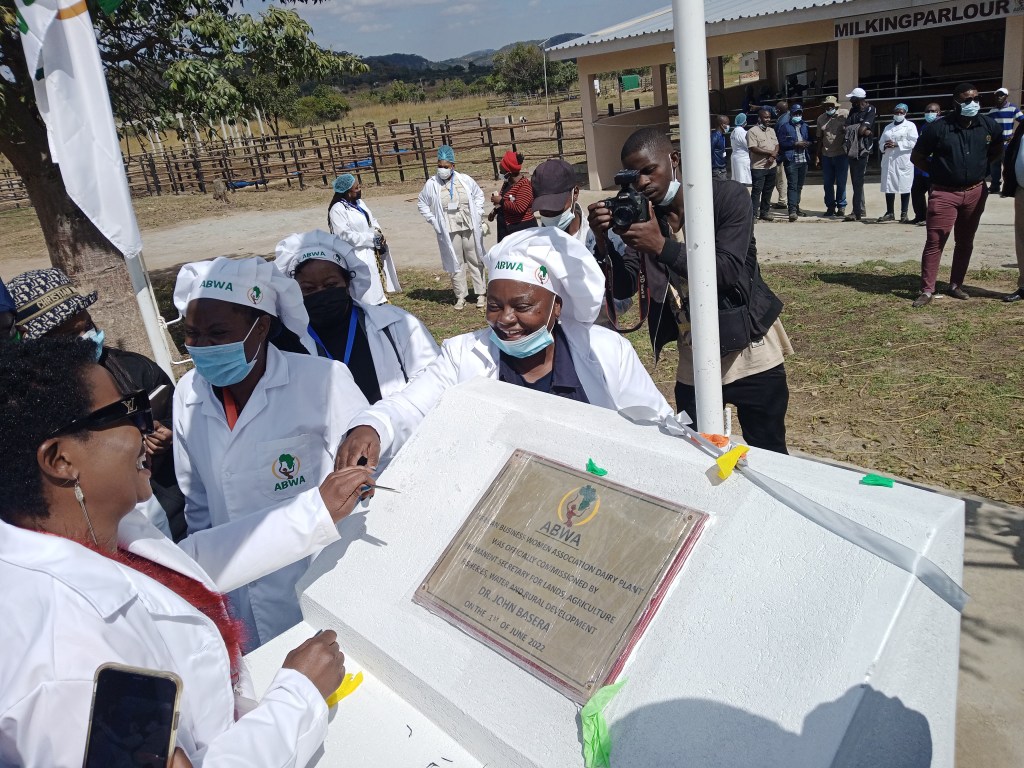
The event coincided with the commissioning of the ABWA dairy processing plant. The theme of this year is, “Dairy Zero Net” and in keeping with this year’s theme, the tour of the dairy scheme highlighted the work being done to accelerate climate action and help reduce dairy sector’s impact on the planet.
Guest of honour at the event, permanent secretary in the Ministry of Lands, Agriculture, Fisheries, Water and Rural Development had his speech read on his behalf by Rutendo Nyahoda.
“Milk is an important part of a healthy balanced diet and this World Milk Day provides the perfect opportunity to spread the word. As you may be aware, the diary industry contributes to food and nutrition security and thus an important component of NDS1”, read Nyahoda.
“Food and Agriculture Organisation (FAO) estimates that around 150 million households (750 million people) are engaged in production around the world”, she added.
ABWA chief executive officer Shamiso Fred in her remarks said she was motivated to start the agriculture projects by the need to empower the people of Zimbabwe.
The 49 – year- old founder was born and bred in the Chiriseri village hence she saw it beffiting to come back and invest in the community that raised her.
“The Chiriseri villagers are very special to ABWA as they are the ones who made us what we are today”, said Fred. Having been into poultry business, consultants asked her why she couldn’t start a dairy scheme. The idea of a dairy was born in March 2022.
“I am pleased with the venture because we have achieved in a year what our financial advisers had assumed could be achieved in 5 years”, she said in an interview. “We started with 10 cows and the number has grown to 250 cows”, she added.
Since it’s formation ABWA has since evolved and now incorporates manufacturing, value addition and beneficiation which has necessitated the construction of a diary processing plant at ABWA farm. They are also into social responsibility whereby they are sewing uniforms for underprivileged students in the area, giving food in schools and introducing farming projects in schools. Also she has helped some employers to study at tertiary level. The land she is operating on has been donated by villagers and relatives in the area.
She pleaded with the government to help the dairy sector with milk machines and other funds to help in the easy way of doing business. She also bemoaned the bad road leading to the farm. ” The about 29 km road which leads to our farm is in bad state causing travelling to be boring as long hours are experienced and rough rides”, she said. She saw it imperative for the council and the government to rehabilitate the roads. The Zimbabwean government has the mantra “Zimbabwe is Open for Business”and good roads help the business to thrive.
Chief dairy officer led the procession of delegates who toured the diary scheme and the dairy processing plant was then commissioned
The tour led to the hatchery or laboratory section, feed section, calves pens, diary processing plant and the milk parlour respectively.
At the laboratory, Nomatter Muzonzini, ABWA food technologist said it was essential for the milk to be tested at every stage for them to know which product to make and also for the benefit of having quality products in the market. At the feed the farm representative said the farm was not yet able to have its own feed thereby buying raw materials like maize from the community.
At the calves pens, Fatima Tuwa veterinary technician said the calves are given 1 to 2 litres a day, they are first given 500 millilitres and then increased up to 2 litres uptake as the day progresses. Alois Mutimbo a diary specialist at the diary processing plant explained how the milk and other products are processed. The farm at the moment has a 10 000 litres cold room to store finished products.
At the milk parlour, the organisation highlighted that they were using mobile milking machines instead of fixed milking machines. Fixed milking machines which range between $50 000 USD and $75 000 USD have a pipe which transport the milk to the milk tank instantly.The fixed milk machines are too dear in costs for the diary scheme although they make the job easier.
Dr Piuos Makaya, director of veterinary and technical services in the Ministry department of veterinary services commended the dairy processing plant commissioning ” As the world is celebrating the World Milk Day, this is an achievement in the industry. This is not going to help only the farmers who supply milk but also the community at large”, said Dr Makaya in an interview.
Ward 11 councillor in Bindura Rural District Council Cllr Steve Masango applauded the dairy scheme. “This is going for the community as it creates jobs and availabity of food and milk supply nearby.As a person who represents people , I am very happy with this”, said Masango in an interview.
ABWA was founded in 2013 and it’s headquarters are located in Zimbabwe , it has presence in South Africa, Ghana, Nigeria and United Kingdom.
 News Sport Online